Cunning Folk

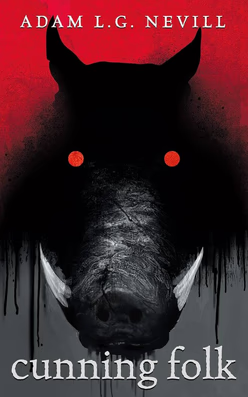
Tom and Fiona are a young working-class couple who’ve scraped together enough to buy a semi-detached house in rural south England. The previous owner hanged himself leaving the property in disrepair. The roof, plumbing, floors, walls, everything needs work. Even so, the mortgage is killing them.
Then they meet the neighbors, who are old, strange, and immediately hostile. Their side of the shared wall is immaculate—lush garden, fresh paint, ruler-straight roof tiles. Tom’s side looks like the Somme. Strangers begin arriving at odd hours to pay the old pair what can only be called tribute. When terrible things start happening to his four-year-old daughter, Tom realizes he is up against more than cranky old coots.
This is the premise of Adam Nevill’s Cunning Folk, and it’s a good one. It is not, unfortunately, a good novel.
Nevill writes in present tense with a clean propulsive energy, and when he’s cooking, he’s genuinely frightening. A nightmare sequence involving old gods and folk horror belongs in an anthology of the form’s best passages. Later, there’s what Nevill himself calls “a permanent harm to the writer scene”—I won’t say more, except that it shocked me, and I don’t shock easily. The man has talent, which makes his failures all the more maddening.
Tom, the novel’s third-person center, proves its biggest problem. He’s a freelance graphic designer with no work, a mortgage he cannot afford, and a personality assembled from equal parts self-pity and obliviousness. Nevill seems to intend him as a symbol—the crushed dream of working-class home ownership in modern England—but symbols don’t need to act stupid on purpose, and Tom acts stupid on purpose. Constantly. He withholds information from the one person who might help him. He sits and drinks rum when obvious action presents itself. In a screenplay these are “he can’t do X or the movie ends” moments. In a novel, where we’re trapped inside his head, they’re simply infuriating.
The horror movie comparison is inescapable. Not the good kind of horror movie. The kind where you spend ninety minutes shouting at the screen while characters ignore exits, trust strangers, and split up in the dark.
The prose stumbles, too. Nevill leans on repetition—“blurred,” “dizzy”—trying to force moods.
Then there’s the tone. In a memorable sequence, Tom stumbles upon a severed head. About to be sick, he runs to the bathroom only to find more body parts in every fixture — sink, bathtub, toilet — while desperately trying to hold back the bile. It’s a great bit—Shaun of the Dead energy—but it sits uneasily beside the novel’s darker, more earnest passages.
The author’s notes at the end are illuminating. Cunning Folk began as a screenplay—Nevill’s second—before three years in development hell pushed him toward the novel. He spent six weeks on the script and fourteen months on the book. Those ratios explain much. The screenplay’s bones are still visible beneath the novel’s skin: rigid structure, a protagonist whose inner life was meant to be supplied by an actor, setpieces the author couldn’t bring himself to cut. An actor manufactures charisma. A reader follows thoughts. Tom’s thoughts are not worth following.
I almost gave up on this one several times. But I kept on, hoping the ending would deliver. It doesn’t, but it comes close.
And that’s what makes this all the more frustrating—the sense of what it almost was. A proper trap story—something that clicks shut at the end like a locked room mystery, the final image making everything before it feel inevitable—was within reach. Better plotting, a more accountable protagonist, a steadier comedic hand, and Cunning Folk might have been remarkable.
As is, we’re left with neighbors who are apparently powerful enough to terrorize a family with dark magic and yet cannot scrape together an offer on the adjoining property.
Nevill is good enough that I’ll read him again. Just not one that started as a screenplay.
Reading History
- 2026Mar26ThuEbook
Read over 11 Days
- 16 Mar 20264%
- 17 Mar 20269%
- 18 Mar 202621%
- 19 Mar 202640%
- 20 Mar 202674%
- 21 Mar 202681%
- 22 Mar 202687%
- 26 Mar 2026Finished
-