Once Upon a Time in Hollywood

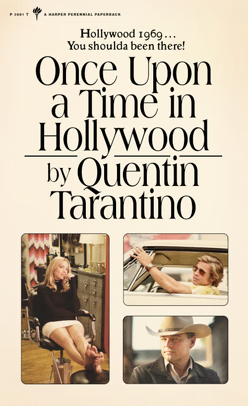
Quentin Tarantino has novelized his own movie, and the first surprise is that he appears to have decided the film got some of it wrong.
In the film, Rick Dalton meets the agent Marvin Schwarz over drinks in a restaurant. In the book they meet in Schwarz’s office at William Morris. Same offer, same washed-up TV cowboy advised to go make spaghetti Westerns, same tears. Different room. Every scene the two versions share has been nudged a few inches like this. The effect is peculiar and, once you catch on, delicious. Tarantino isn’t adapting his film. He’s filing a correction to it.
The trick works because he sews Rick and his stunt double, Cliff Booth, so tightly into real Hollywood history that the seam disappears. You are asked to believe 1969 went this way, and the picture merely tidied it for the camera. Of course an omniscient narrator is doing the telling, and omniscient narrators have their own agendas. In Rick Dalton’s world there would be four books about that summer. This is the one written by the guy who liked him.
Be warned that the book assumes you have seen the film, and assumes it aggressively, tossing off the movie’s ending in a Chapter 7 aside with twenty chapters still to go. The novel closes on a scene that was shot for the movie and cut from it, involving nobody named Manson. But it’s more than a collection of deleted or extended scenes. It’s a chronicle assembled by a man who could not stop thinking about his own characters.
Most of that thinking goes to Cliff Booth. We get his war, his vagabond years after, his wife’s death and his part in it. Best of all, we get his taste in movies. Cliff came home from the Pacific unable to sit through Hollywood war pictures because he had seen the merchandise firsthand and found the studio version phony. So he went looking elsewhere and landed on Kurosawa and Mifune in the foreign houses where the violence had weight and the characters felt true. A stunt man who reads subtitles. None of this rearranges the man so much as it fills him in and better explains his laconic nature.
The same goes for the Bruce Lee fight. Those who left the theater fuming will find it staged here with more detail. After getting thrown, Bruce realizes that Cliff has killed men with his bare hands, and that “Cliff wasn’t fighting Bruce Lee. Cliff was fighting his instinct to kill Bruce Lee.”
As good as Tarantino’s real-history stitching is, his invented material may be even stronger. Early on, a teenage Sharon Tate thumbs her way out of Texas and gets picked up by a rodeo rider whose last ride was a humiliation and whose next one, in his hometown, is going to fix everything. He is called Ace Woody. He is also Junior Bonner wearing a false name, which means Peckinpah’s make-believe has wandered into Tarantino’s and the two of them are sharing a truck cab. Later, Cliff doubles for Rick in Spain and runs into Aldo Ray, drunk and finished, and sneaks him a bottle of gin. Tarantino writes a eulogy for a talent nobody bothered to mourn, and leaves you wondering whether Ray was drinking to escape what he saw in the war.
Now the nits. Rick’s monologue dismantling the legend that he nearly got Steve McQueen’s part in The Great Escape is a wonderful scene, and it is absolutely not Rick talking. It’s Quentin, doing Rick. When a Manson girl hears Charlie call her “kiddo,” I hear David Carradine instead. Bill was always a Manson with better swords. And no copy editor was ever introduced to this manuscript. Chapter 7 has Rick drinking to medicate an undiagnosed bipolar condition. Chapter 20 blames “self-loathing, self-pity, and boredom.” Chapter 22 pauses to identify Rick as Cliff’s boss, in case we wandered in late.
None of that costs the book much. Like the film, it’s a hangout, and hangouts are graded on company. If you enjoyed the company of these two before, you will enjoy 400 pages of it now. If you didn’t, Tarantino hasn’t written this for you and shows no sign of losing sleep over it.
I had a good time. I would have had a slightly better one with a braver editor.
Reading History
- 2026Jul29WedEbook
Read over 5 Days
- 25 Jul 202616%
- 26 Jul 202631%
- 27 Jul 202662%
- 28 Jul 202680%
- 29 Jul 2026Finished