Paint My Name in Black and Gold
The Rise of the Sisters of Mercy

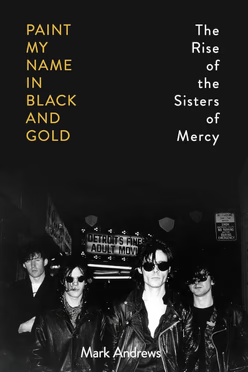
Mark Andrews’ exhaustive oral history captures a band in ascension—and a brilliant manipulator at work.
The Sisters of Mercy emerged from Leeds in 1980 like a sonic assault. Loud. Smoky. Relentless. Andrews chronicles their meteoric rise through the voices of everyone who was there: band members Craig Adams and Mark Pearman (later Gary Marx), promoters, roadies, sound engineers, and Claire Shearsby, the influential DJ who dated frontman Andrew Taylor (later Andrew Eldrich). It’s ambitious reporting. It’s also exhausting.
The first third drowns in names. Pearman becomes Gary Marx becomes Gary becomes Marx becomes Mark again. Supporting players drift in and out like ghosts at an afterparty. English slang doesn’t help. (Winkle pickers are shoes, apparently.) But stick with it. As the band’s orbit tightens, the narrative finds its footing.
What emerges is the portrait of an enigma. Taylor/Eldrich got into Oxford, flamed out, landed at Leeds, and manufactured a band from scratch. He designed the logo. The artwork. The stage show. The lyrics. While Joy Division and The Cure paid their dues through endless rehearsals, the Sisters simply appeared—under-rehearsed but over-presented, compensating with volume and smoke machines. Shows were coin-flips between brilliant and dreadful.
But the persona worked. Taylor became Eldrich, rock god. The transformation required amphetamines and ruthless ambition. Friends became obstacles. Eldrich slow-dripped speed like Adderall, achieving superhuman focus—drum tracks mapped on graph paper, hand-typeset lyrics. The turning point arrives when recording “Temple of Love.” Where earlier songs emerged from demos or live shows, this one Eldrich constructed alone, spending days in the studio perfecting drum sounds while his bandmates watched. The result: their biggest single.
Andrews interviewed Eldrich. Yet the man remains opaque. His motives, his thoughts—nothing breaks through. We get observations about him, never from him. Did the interview yield anything? You’d never know.
Here’s the bigger problem: this is only Act One. The book ends with the original lineup’s dissolution in 1985. Everything after—the even more successful Floodland, the second breakup, the brilliant Vision Thing, Eldrich’s decades-long refusal to release new music—gets relegated to an epilogue.
Small-town band makes good, records major label album, falls apart? That’s a familiar story. What’s remarkable is what Andrews doesn’t cover: Eldrich rebuilding twice more, each time more successful, like lightning striking three times. That’s the real testament to his genius.
Only Eldrich could write that story. He won’t. The persona won’t permit the introspection required. A gifted writer who’s contributed to Rolling Stone, he’s trapped in the character that freed him.
What a shame. What a read that would be.
Still, Paint My Name in Black and Gold is valuable for what it captures—the machinery of mythmaking, the cost of transformation. Andrews has written half a great book. The first act is there, stuffed with too many characters but ultimately compelling. The rest remains untold.
Reading History
- 2025Dec20SatEbook
Read over 78 Days
- 4 Oct 20255%
- 5 Oct 20258%
- 13 Oct 202511%
- 8 Dec 202520%
- 9 Dec 202530%
- 11 Dec 202541%
- 12 Dec 202553%
- 13 Dec 202558%
- 17 Dec 202562%
- 20 Dec 2025Finished
-