Long Live Mortal Kombat
Round 1 - The Fatalities and Fandom of the Arcade Era

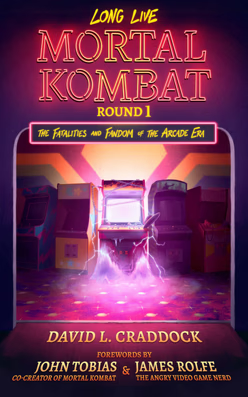
Mortal Kombat was made in Chicago by a former pinball company that, in the early 1990s, wanted a fighting game starring a digitized Jean-Claude Van Damme to go with Universal Soldier. Van Damme passed, so the programmer Ed Boon and the artist John Tobias got to make their own game. They repaid the actor with Johnny Cage, a preening movie star whose signature move is a split that ends in a punch to the groin.
David L. Craddock’s Long Live Mortal Kombat: Round 1 arrived in 2022 for the game’s 30th birthday, and I have come to it late, which is how I come to most things involving joysticks at my age. Craddock begins in the arcades and lingers happily at Acclaim, the publisher that put Mortal Kombat on four home systems on the same day in 1993 and called it Mortal Monday. If you were young then, you remember the commercial.
The trivia is the best of it. Liu Kang is named for Gordon Liu, the Shaw Brothers star who would later stroke a long white beard and torment Uma Thurman in Kill Bill: Vol. 2. The theme from the 1995 movie was recorded by members of Lords of Acid under the name The Immortals, a wise choice, since the titles of most Lords of Acid songs cannot be printed in a family newspaper.
An unreleased version of the first game, code-named Nitro, changed the endings and costumes depending on whom you had finished off with a fatality. Midway shelved it to make room for the sequel, which is a shame, since a game that remembers your cruelty and makes you wear it is the most interesting idea in the book. And the network code for the PC version of Mortal Kombat 3 was written by Oren Peli, who went on to direct Paranormal Activity. The audiobook, sadly, does not end the passage with Jack Palance saying, “Believe it… or not.”
Craddock is less sure what to leave out. When the actors filmed for the original game sue Midway, he halts the story for what amounts to an introductory course in copyright law. I wanted to know how it felt to see your own body sold in arcades a quarter at a time, and how Boon and Tobias felt as parties to it. I got the syllabus.
The bigger trouble is who isn’t here. Craddock talks to executives at Midway and Acclaim, but Tobias contributes a foreword and little else, and Boon contributes nothing firsthand at all. Tournament players walk us through frame advantage, the crossover attacks of the second game, and the run-jabbing of the third, and they’re clear enough that I, who have never run-jabbed in my life, could follow. What they can’t say is which of those things Boon intended and which ones surprised him. The same silence falls over the move to polygons and three dimensions for Mortal Kombat 4, a direction the series later partly reversed. A decision like that has a story behind it, and Craddock mostly tells us when it happened.
The movies get odder treatment still. The making of the first gets a full and lively account, while Mortal Kombat: Annihilation gets little more than a note that it underperformed. That’s one word for a movie that kept the franchise out of theaters for over two decades. We aren’t told why so much of the cast was replaced or why Paul Anderson didn’t return to direct. Maybe Craddock couldn’t find anyone willing to talk, or maybe he didn’t want to speak ill of something he loves.
Casual fans should leave this one alone. The audiobook runs 21 and a half hours, which is more than their interest will cover. The devoted will read it no matter what I say and will learn a few things, though I doubt many will call it a fair trade. The title promises a Round 2. I hope Craddock gets Boon on the phone first.
Reading History
- 2026Oct16FriAudiobook (Read by Andy Ingalls)
Listened to over 31 Days
- 16 Sept 20265%
- 17 Sept 202616%
- 18 Sept 202623%
- 19 Sept 202630%
- 22 Sept 202634%
- 25 Sept 202641%
- 26 Sept 202646%
- 27 Sept 202650%
- 28 Sept 202660%
- 3 Oct 202667%
- 4 Oct 202669%
- 11 Oct 202671%
- 13 Oct 202687%
- 16 Oct 2026Finished